Friday, 22 December 2017

Diamond Tales: The Diamonds of Sint-Nicholaas by Cryssa Bazos


The English Civil War is over, and Charles (acclaimed as Charles II) is in exile with many of his supporters. The time and the place is fraught with danger, for who knows who is watching and why...

The Diamonds of Sint-Nicholaas
by
Cryssa Bazos


A new land with the promise of a fresh beginning beckons—or does it? Following on from the pages of Traitor’s Knot and what awaits James and Elizabeth Hart in the Netherlands in the seventeenth century...

Two weeks after arriving in Holland, Elizabeth and James Hart were just another group of English exiles flooding The Hague, despite his service to the Crown. Though he denied it, Elizabeth knew James was worried. She’d often caught him brooding over his prized token, turning the royal coin, thumb over forefinger. The golden profile of Charles Stuart winked in the firelight, minted when the promise of regaining his English throne had not yet been dashed. This coin should have granted James an audience with Charles’s sister, the Princess of Orange, and from that, possibly a lease of lands, but the guards of the Binnenhof had their orders. The Princess would see no one.
“Perhaps if you wrote to…William Jackson,” Elizabeth suggested, substituting the name they called Charles Stuart even in private. “Let him know you’re here.”
James shrugged on his coat and adjusted his sleeves before answering, “I have – the day after we arrived.”
“She could make an exception and welcome the man who saved her brother.”
“Cromwell’s spies are everywhere, infiltrating Royalist circles,” James said. “The Princess needs to be careful as to who she receives.” He brushed a kiss on Elizabeth’s forehead. “I’ll somehow find a way, my love.”
Elizabeth watched from the frost-laced window as he emerged into the street below. As he had every day these past two weeks, James headed down the cobbled street towards the stables where he kept a stall for Sovereign. Each day had been the same. Ride out into the city to connect with other Royalists; find someone who had the Princess’s confidence.
Their landlady’s son, Pieter, darted across James’s path with his stick and ball, the lad’s white-blond hair ruffling as he ran. Normally, James would have called out a greeting to him, but this morning he barely seemed to notice.
A gentleman walking in the opposite direction stopped James to ask a question. The man’s silver hair and white lace collar stood out against the darkness of his velvet cap and cloak. They spoke a moment before parting. James glanced back at the man before continuing on his way.
Elizabeth stepped away from the window. This was her morning ritual, before she fed their infant son, Thomas, but she never owned to it. Soon their maid, Jennet, was stirring the embers and her father-in-law had risen to break his fast.  
Their lodgings were crowded and carried a lingering dampness. Wide wooden planks, knotted and rough, were begrimed with layers of soot that had deposited into the crevices, beyond the reach of a scrub brush. Elizabeth craved fresh air and the refreshing scent of salt on the breeze, but she daren’t open the window for the acrid scent of tar and muddy canal would have filled the room. Her father-in-law’s chill had worsened, and this would have further aggravated his condition.
The only redeeming feature of the room was the blue and white Delft tiles surrounding the hearth. Diamonds graced the corner of each tile, and at their centre, a figure charged on horseback. He was a clever fellow wearing a Dutch-styled hat with a jaunty feather. His cloak bellowed out, and the horse reminded her of Sovereign. When the landlady had first shown them the room, Elizabeth drew James aside and pointed to the tiles. “A promising omen, surely.”
Down the flight of stairs, the door opened, and the smells of cinnamon and nutmeg wafted upward. Elizabeth spied the top of Pieter’s white head, but he remained crouched mostly out of sight. 
“I see you,” she said, as a way to invite him inside. “What is your mother baking?”
Quick as an arrow, Pieter dashed up the remaining steps. “Treats for Sinterklaasfeest.” The lad spoke with a heavy Dutch accent. “Sint-Nicholaas will be in harbour tonight, and he’ll fill my shoes with treats!” He then rhymed off his favourite biscuits.
Pieter!” The landlady called out from the bottom of the stairs.
“I must leave, Mevrouw,” he whispered to Elizabeth before creeping back downstairs.
A few moments of silence were shattered by Pieter receiving a scolding. Elizabeth didn’t need to fully understand Dutch to realize she was warning her son away from them. The woman treated them no better than lepers, except that she welcomed their coin.
Her father-in-law settled himself on a stool by the fire. The rattling cough in his chest had worsened and needed to be treated. His skin was pallid and clammy.
“Here, Father.” Elizabeth placed a cool compress across his forehead. If she had her stores of herbs, she could have mixed a warm poultice for him. “I’ll seek out an apothecary. There must be one nearby.”
Elizabeth left Thomas with Jennet and headed out. She found her landlady sweeping the doorstep. A grey woollen shawl was draped across her broad shoulders, and the tip of her nose was bright red.
Apotheker? Ja.” the woman said in response to Elizabeth’s question. She gave brusque directions before returning to work.
Elizabeth followed the winding streets. There was a crackle in the air as people rushed to get their work done before the eve of St. Nicholas. She jostled her way down the crowded streets, past slow moving carts filled with goods. Tempers became frayed, and a fight nearly broke out over an overturned barrel of oranges. 
The sign of a mortar and pestle indicated she’d found the apothecary. Above the door, a tinkling bell sounded as she entered. Behind the counter, a thin man measured a white powder on a scale. He barely glanced up and said, “Een moment, Mevrouw.”
While she waited, Elizabeth looked around the shop. A sudden wave of nostalgia for her aunt’s stillroom swept over her. Glass jars filled with dried compounds filled the shelves. A small fire burned in the brazier. “I need some assistance, sir.”
The man’s brow lifted, and his tone turned to annoyance. “Ik spree geen Engels.” He returned to the scale and continued his work.
Elizabeth realized her error. She should have brought someone with her who knew the language. Even Pieter could have helped.
The bell jingled behind her, and a gentleman entered the shop. He wore a black broadcloth coat with a crisp lace collar. A black, velvet cap was set atop thick silver hair. Elizabeth recognized him immediately – the man who had passed James on the street.
Gooten morgen,” he said with an elegant nod.
Elizabeth returned his greeting, her tongue tripping over the unfamiliar words.
“Perhaps then I should say good morning, Mistress.”
Elizabeth smiled in relief, for this man was clearly a countryman. “Glad I am to hear the King’s English spoken.”
“Do they still call it that?”
The archness of his question made Elizabeth uneasy. She should have taken better care with her words. Too late she remembered James’s warning of Cromwell’s spies. “Forgive me, but you look familiar.”
The gentleman bowed slightly. “Sir Edward, at your service. Scribe and scholar.”
“You were walking along Lau Mazirellaan earlier and spoke to my husband.”
“Indeed. I take an interest in every corner of this fair city and mark every flower and bird that I come across. People too,” he said. “And your name, Mistress?”
She hesitated a fraction. “Elizabeth Hart.”
“Hart?” The man’s smile deepened. “Very pleased to make your acquaintance.”
Elizabeth glanced at the apothecary who was, by now, following their conversation with open interest. She couldn’t tarry any longer and addressed him, “Do you not speak the least English, sir?” 
“Perhaps I can translate?” Sir Edward said. 
Elizabeth set aside her reservations. Her father-in-law needed his physic, and Sir Edward carried himself with courtesy. “I must make a poultice of mustard seed and mint to relieve the ague. A tincture of water-agrimony as well.”
Sir Edward translated, and the apothecary responded enthusiastically. He even gave Elizabeth a nod of approval. Off he jogged to his storeroom.
“You are far from home, Mistress,” Sir Edward said while they waited.
A rush of melancholy assailed Elizabeth. “We had no choice. One day I hope we will return.”
“May the future hold more promise,” he said. “But know, you are not alone.”
The apothecary returned with the items and included a bag of lavender.
“To sweeten the air,” Sir Edward translated.
Dank je,” Elizabeth said directly to the apothecary.
“Now that you have everything in hand, Mistress, I must take my leave.”
“But I have interrupted your business, sir,” she said. “You have not purchased a single item.”
Sir Edward smiled. “I have no need for an apothecary.”
The hairs on her nape lifted. Her initial unease flared again. “Then why are you here?”
He appeared to be measuring his response before he replied, “An acquaintance asked me to find a diamond in a coal bin, a truly difficult matter to accomplish with discretion. In these dim times, one may not easily discern between gems and glass.”
Elizabeth frowned trying to puzzle his meaning. “Do you have your answer?”
Sir Edward smiled and tipped his hat. “God speed, Mistress Hart. Give my regards to your husband.”


As the shadows lengthened and the streets grew more settled, Elizabeth drifted to the window to wait for James’s return. Perhaps today he’d return with good news. She spied him coming down the street, his gait slow and his shoulders hunched forward. With a sigh she stepped away from the window. They’d have to wait another day. 
James’s footsteps sounded on the creaking stairs, and Elizabeth rushed to greet him. She thought to mention Sir Edward, but James’s weariness made her put it aside. Later. Elizabeth linked her fingers with his and drew him to a seat by the fire. When she would have gone to fetch him his supper, James halted her with a touch. His arm curled around her waist, drawing her closer to him. His grey eyes were shadowed, and he searched her face without saying a word. She stepped into his embrace and wrapped her arms around him, holding him tight.
“I’ve done what I could, love,” he admitted to her in a low tone. “What connections I thought I had, I can’t find. My old commander, the Earl of Northampton is away from the city, and his servant won’t admit to his whereabouts or accept a letter on his behalf. There’s a rumour of the king’s factor in the city but no one can say who he is. If he exists, he’s well hidden.”
“Forget the token,” she said. “We’ll find another way to seek our fortune.”
After a moment, he said, “You deserve better.” 


The next morning, James did not leave their lodgings. He spread out a backgammon board between himself and his father. Little Thomas sat on his lap and gnawed on one of the draughts. The door creaked at the bottom of the stairs, and Pieter dashed up to the second floor.
Mevrouw, I got an orange in my shoe!”
Elizabeth noticed that he held a sealed letter, and the lad seemed to remember it at the same time. “A gift for Mijnheer,” he said, handing the letter to James. “From Sint-Nicholaas. He must not have known where your shoes were, for he left it outside our door.”
James cracked the seal, and his eyes widened. He looked up, and for the first time in two weeks, he gave her an unguarded smile. “As the lad says,” he said handing her the letter. “A gift from Sint-Nicholaas.”

“Your audience with the lady has been arranged, compliments of William Jackson.
Your humble servant,
Sir Edward Nicholas.”

An image of a diamond had been pressed into the seal. Elizabeth glanced at the blue and white Delft tiles with the horseman encircled with diamonds.
A good omen indeed.

© Cryssa Bazos


Cryssa Bazos is an award winning historical fiction writer and 17th century enthusiast with a particular interest in the English Civil War. She is a member of the Historical Novel Society, the Romantic Novelist Association and is a co-editor and contributor of the English Historical Fiction Authors blog. Her debut novel, Traitor's Knot, is published by Endeavour Press.

Amazon http://mybook.to/TraitorsKnot
Read Our Review

About Traitor’s Knot
England 1650: Civil War has given way to an uneasy peace in the year since Parliament executed King Charles I.
Royalist officer James Hart refuses to accept the tyranny of the new government, and to raise funds for the restoration of the king’s son, he takes to the road as a highwayman.
Elizabeth Seton has long been shunned for being a traitor’s daughter. In the midst of the new order, she risks her life by sheltering fugitives from Parliament in a garrison town. But her attempts to rebuild her life are threatened, first by her own sense of injustice, then by falling in love with the dashing Hart.
The lovers’ loyalty is tested through war, defeat and separation. James must fight his way back to the woman he loves, while Elizabeth will do anything to save him, even if it means sacrificing herself.

Traitor's Knot is a sweeping tale of love and conflicted loyalties set against the turmoil of the English Civil War.


Follow the Tales…and Discover some Diamonds

3rd December     Richard Tearle Diamonds

4th December     Helen Hollick  When ex-lovers have their uses

5th December    Antoine Vanner  Britannia’s Diamonds

6th December    Nicky Galliers  Diamond Windows

7th December    Denise Barnes  The Lost Diamond

8th December    Elizabeth Jane Corbett A Soul Above Diamonds

9th December    Lucienne Boyce Murder In Silks

10th December    Julia Brannan The Curious Case of the Disappearing Diamond

11th December    Pauline Barclay Sometimes It Happens

12th December    Annie Whitehead Hearts, Home and a Precious Stone

13th December    Inge H. Borg  Edward, Con Extraordinaire

14th December    J.G. Harlond The Empress Emerald

15th December    Charlene Newcomb Diamonds in the Desert

16th December     Susan Grossey A Suitable Gift

17th December     Alison  Morton Three Thousand Years to Saturnalia

18th December      Nancy Jardine   Illicit Familial Diamonds

19th December      Elizabeth St John The Stolen Diamonds

20th December      Barbara Gaskell Denvil Discovering the Diamond

21st December       Anna Belfrage   Diamonds in the Mud

22nd December       Cryssa Bazos    The Diamonds of Sint-Nicholaas

23rd December        Diamonds … In Sound & Song 

Thursday, 21 December 2017

Diamond Tales: Diamonds in the Mud by Anna Belfrage


This little story assumes that Edward II did not die in September of 1327 but instead was smuggled out of England to live out his life in Europe. Anna Belfrage is not the only person expressing doubts as to Edward II’s death – historian Ian Mortimer is of the same opinion. 

Diamonds in the Mud

By

Anna Belfrage


“Bruges? Why Bruges?”
“Why not?”
“Because it is in the wrong direction?” Egard said. “We’re supposed to go south. Italy you said, m’lord, not Bruges.”
“Ah.” Edward tapped his nose. “I changed my mind. Happens my dear friend the Pope  suggested I go to Bruges.”
“The Pope?” Egard slid his lord a look. Well, lord and lord: Egard had been given the lifelong task of ensuring Edward of Caernarvon, until recently King Edward II, never returned to England, which made him as much Edward’s jailer as his servant.
Edward grinned. “A man of a tender conscience, is our John. And as he can’t help me reclaim my throne, he offered to help me in another way.”
“You can’t reclaim your throne,” Egard said. “If you try, I must kill you.”
“If you can,” Edward replied. He held up his hand. “I have no desire to claim my throne. It would oblige me to punish my son – brutally – and I don’t want to do that. He’s his mother’s pawn in all this. Besides, the Pope’s compensation sounds interesting.”
“Gold?” Egard hoped so. Aye, they were travelling with heavy purses and had some further treasures in the safekeeping of a Lombard banker, but Edward was a man of expensive habits. Only the best wine, the softest linen for him. And as to horses… Egard eyed his companion’s mount and sighed. A horse like that attracted more attention than they needed. Not that anyone but a fool was out and about on a day like this. Egard sniffed the air: snow in the making and already the wind was rising, gathering speed over the flat landscape that surrounded them.
“I’d hazard we will find out soon enough.” Edward set spurs to his horse and set off in a burst of speed before bringing the beast to an abrupt halt. “Egard!” he yelled. “Come!”
Far less spirited, Egard’s mount had to be coaxed into a reluctant canter, the heavy hooves thudding against the ground.
“Look,” Edward said when Egard caught up with him. He pointed at several birds flying in circles some distance away.
“A dead sheep?” Egard suggested, narrowing his eyes. Crows and a couple of kites. Whatever it was, Egard would wager it was dead.
“I think not.” Edward was already guiding his horse towards the birds. “Can’t you see the cart?”
Egard wasn’t about to admit that his eyesight was far less keen than that of his lord, albeit Edward had at least a decade on him.
They halted their horses some distance away from the upended cart. A litter was lying on its side, spilling pillows and torn covers. Three dead men-at-arms lay staring at the grey sky, to the side a frail old man was moaning, his limbs churning the bloody mud in which he was lying. From beneath the cart came the sound of someone weeping and under a stand of shrubs was a woman. Dead, Egard reckoned, the wind lifting the thin, bloodstained material of her veil.
“Robbers?” Egard asked, dismounting. Edward was already moving from body to body.
“It would seem so.” Edward sounded grim. “May the good Lord receive these unfortunate souls into Heaven.” He closed the eyes of the dead men and knelt beside the old man. “Help me turn him over.”
Egard did as told and used a corner of his cloak to wipe some of the mud away from the man’s face.
Guiseppe! Dove è Guiseppe?” the old man said.
“Eh?”
“It’s Italian,” Edward said. He spoke, a rapid collection of words that meant nothing to Egard. He left the old man in Edward’s care and went to inspect the cart. Trapped beneath it was a lad, his fine garments torn and muddied.
“Can you move?” Egard asked in French. In response the lad pointed at his leg, pinned to the ground by the cart.
“If you lift, I’ll pull him free,” Edward suggested, grimacing when his fine new boots sunk to their ankles in the mud.
It took several tries. Egard was sweating with exertion and out of breath by the time the lad was dragged free, squealing like a stuck pig. The old man crawled towards them, repeating the lad’s name over and over.
“His leg is broken,” Egard said, studying the lad’s misaligned leg.
“Aye.” Edward said something to the old man who chattered right back, all the while wringing his hands. Edward nodded. “We have to get the lad to a physician. Do you think we can use the litter?” he asked Egard. “Harness it to our horses perhaps? Those accursed robbers stole their horses as well—and all their valuables.”
“We can try.” Egard gestured at the dead. “What do we do with them?”
“What can we do? The ground’s frozen solid.” Edward pursed his lips. “Maybe we could cover them with the cart.”
“And the woman?”
Edward turned to the old man and received an earful of high-pitched sounds in return.
“His daughter,” he explained. “She must go with us.”
“Poor lad, to share the litter with his dead mother.”
“Sister, actually. And it can’t be helped.”
The old man insisted on wrapping his daughter alone, tucking the folds of her garments tight round her body. Only when she was entirely shrouded did he allow Egard to carry her to the litter.
An hour or so later they were finally on their way, Egard and Edward on foot. “How fortunate they were headed to Bruges,” Egard commented.
Edward snorted. “My dear Egard, every merchant in the world heads for Bruges. From the north come the members of the Hanseatic League, from Castile come the wool merchants and from Italy come those who deal with the luxuries of the far east.”
“So what luxuries did those robbers steal?”
“Silk, mostly.”
“Well, they have nothing to sell now. I hope they have friends in Bruges, otherwise they’ll likely starve.”
“Hmm,” Edward said, his bright blue eyes narrowing as he studied the old man, at present astride Egard’s horse. “For a man who has lost not only his daughter but also all his worldly goods, he remains quite composed.”


Egard shrugged. People reacted differently to tragedies. He glanced back to check on the lad and came to an abrupt halt. The lad was busy with his sister’s clothes, a small knife slashing the seams of her heavy kirtle. “What…” He broke off when one of the seams tore, spilling a multitude of glittering stones. The lad tried to stop them from falling to the ground, but several slipped through his fingers to land in the mud.
“Guiseppe!” The old man somehow made it off the horse and came tottering towards the litter. He spewed words, and this time Egard had no need of a translation. The old man was furious, whacking his son over his head repeatedly.
Egard collected the stones, one by one. A dozen or so lay in the palm of his hand and glittered like drops of ice on a winter morning.
“What are they?” he asked. In response, the old man grabbed his hand. “Mine!” he said in French. “Give them to me. They are mine!”
Egard was too tall and too big for the old man to hold. He shook off the old man as if he were an enervating flea and repeated his question.
“Glass?” Edward suggested, peering down at the little stones.
“Glass?” The old man laughed shrilly. “Yes, yes, it’s just glass. Venetian glass. So give them to me. Please. They’re mine.” He half-sobbed. “Mine.”
“Well, if they’re only glass you won’t mind us keeping these,” Edward said. “A small compensation for coming to your aid.” He smiled – one of those frosty smiles the erstwhile king excelled at, causing men’s bowels to cramp. Egard smothered a chuckle at the look on the old man’s face. Glass? Not likely.
A moan from the lad had all of them looking his way. He had paled, the makeshift bandage round his leg dark with blood.
“We’d best make haste,” Edward said. “The lad may well die unless we get some help.”
“Die?” The old man’s voice quavered. “My son?”
Egard inspected the bandage and covered the shivering boy with his cloak. “How far to Bruges?”
Edward looked north. “Two hours, I’d reckon.”
Egard shook his head slightly. The lad was not doing well.


They arrived in Bruges just as the last of the daylight faded away. Fortunately, the city gate still stood open and they hurried across the narrow bridge over the double moat. Inside the city walls was a network of cobbled streets, of canals and imposing stone buildings rising several storeys in the air. To the distance, a tower rose towards the sky and just as they rode through an arch, bells began to ring, a right cacophony of sounds.
“A huge belfry,” Edward exclaimed, stopping for a moment to gaze at the tower.
Si, si,” the old man said. It was the first thing he’d said since the incident with the glass pebbles. “Rings too often,” he muttered.
“You have been here before?” Egard asked.
Si. Usually, I come by ship.” He waved his hand in a vague westerly direction. “This time by land…” he crossed himself. “More fool I.”
They followed the old man’s directions to a house situated right by the main square.
“Ah, he’s Venetian,” Edward murmured after studying the embellished signs over the closed shop shutters.
“Whatever he is, let us hope his countrymen have access to a good healer.” Egard was already lifting the lad out of the litter. Some moments later, Edward and Egard were left standing in the street with their horses, the stout door to the house shut in their face.
“Well,” Edward said. “Not the politest way of expressing your gratitude.”
“No matter. I need food and a bed.”
“You always need food.” Edward mock punched him. “You eat like a horse, Egard.”
“Best make the best of things. Lent is soon upon us.”
While Egard arranged for stabling, Edward arranged for a room. He had the inn’s pretty maid bring them ale, food and extra wood for the hearth. Egard sat on a stool and leaned back against the wall, extending his feet towards the meagre warmth of the fire. He’d washed hands and face in a bucket of cold water, but blood still rimmed his finger nails.
“Will he survive?” he asked.
“The lad? In God’s hands.” Edward poured them both some ale. “But at least they have the wherewithal with which to pay for excellent treatment.” He pointed at Egard’s pouch. “Give it to me.”
Egard handed it over. Edward carefully shook out the little stones and lined them up on the table. The light from the candles caused them to sparkle.
“These,” Edward said, “are diamonds. Precious stones come all the way from India.”
“Diamonds,” Egard repeated. “Who told you?”
“I asked around while you were seeing to the horses.” He grinned. “The Venetians bring them to Europe and sell them at exorbitant prices.  The Romans believed them to be the tears of God, some say they are remnants of stars that have fallen to earth.” He picked one up and tilted it this way and that, causing the reflected light to set it ablaze. “Beautiful.”
“Aye.” Egard reached for some more bread. “What will you do with them?”
“Sell some, keep some.” He tapped a finger on the table. “And one I aim to send to my son. A constant reminder of the fact that his deposed father still lives.”
“He already knows that, m’lord.”
“I know.” Edward sighed. “Can’t say I envy him, having to cope with dear Isabella and that hell spawn Mortimer.”
“He’s too young to rule on his own.” Egard had long given up on protesting when Edward spoke ill of Mortimer, a man Egard held in very high regard.
“For now.” Edward grinned. “But soon…” He raised his mug. “To my son. May he prevail.”

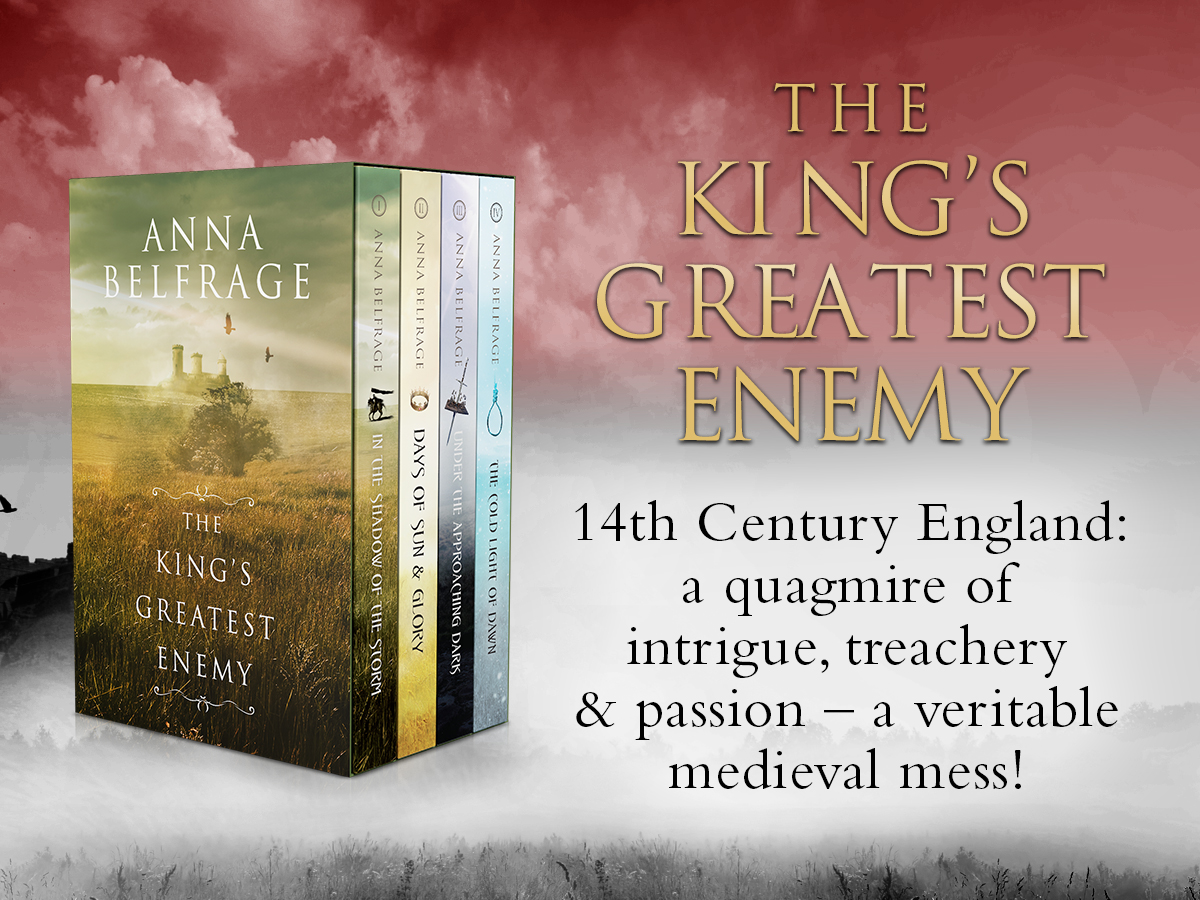
Author’s note: For more about my take on Edward II, Edward III, Roger Mortimer and Isabella, I suggest you read my series The King’s Greatest Enemy featuring Adam de Guirande, a knight torn apart by his loyalties to his king and his first lord, Roger Mortimer. And yes, Egard plays a part too!

© Anna Belfrage


About Anna:
I was always going to be a writer - well in between being an Arctic explorer, a crusader or Richard Lionheart's favourite page (no double entendre intended - I was far too innocent at the time.) Anyway, not for me the world of nine to five, of mortgages and salary cheques. Oh no; I was going to be a free spirit, an impoverished but happy writer, slaving away in a garret room.

Life happened. (It does, doesn't it?) I found myself the bemused holder of a degree in Business Admin, and a couple of years later I was juggling a challenging career, four kids, a husband (or was he juggling me?) a jungle of a garden, a dog, a house ... Not much time for writing there, let me tell you. At most, I stole a moment here or there.

Fortunately, kids grow up. My stolen moments became hours, became days, weeks, months... (I still work. I no longer garden - one must prioritise) It is an obsession, this writing thing. It is a joy and a miracle, a constant itch and an inroad to new people, new places, new times.

find out more:
Twitter handle: @abelfrageauthor

Read our Review
Under the Approaching Dark
Read our Review
Recently Released:
There is Always Tomorrow

Follow the Tales…and Discover some Diamonds

3rd December     Richard Tearle Diamonds

4th December     Helen Hollick  When ex-lovers have their uses

5th December    Antoine Vanner  Britannia’s Diamonds

6th December    Nicky Galliers  Diamond Windows

7th December    Denise Barnes  The Lost Diamond

8th December    Elizabeth Jane Corbett A Soul Above Diamonds

9th December    Lucienne Boyce Murder In Silks

10th December    Julia Brannan The Curious Case of the Disappearing Diamond

11th December    Pauline Barclay Sometimes It Happens

12th December    Annie Whitehead Hearts, Home and a Precious Stone

13th December    Inge H. Borg  Edward, Con Extraordinaire

14th December    J.G. Harlond The Empress Emerald

15th December    Charlene Newcomb Diamonds in the Desert

16th December     Susan Grossey A Suitable Gift

17th December     Alison  Morton Three Thousand Years to Saturnalia

18th December      Nancy Jardine   Illicit Familial Diamonds

19th December      Elizabeth St John The Stolen Diamonds

20th December      Barbara Gaskell Denvil Discovering the Diamond

21st December       Anna Belfrage   Diamonds in the Mud

22nd December       Cryssa Bazos    The Diamonds of Sint-Nicholaas

23rd December        Diamonds … In Sound & Song 
The Importance of Covers an article for Discovering Diamonds by Anna Belfrage

Wednesday, 20 December 2017

Diamond Tales: Discovering the Diamond by Barbara Gaskell Denvil


Today's Tale
we travel to late 15th Century London...

DISCOVERING THE DIAMOND
by 
Barbara Gaskell Denvil


I walked slowly, enjoying the soft splatters of rain on my back and the gentle music of its fall. It trickled from my hair to my shoulders and down from my shoulders to my breasts, and the little damp chill made me feel more alive. In the past I would not have been able to wear my hair loose. A married woman does not parade her hair in the sight of God. But now I do as I wish, and my hair is a curling drip of blonde ringlets. It feels free and I like it.
The path was deeply shadowed, which spun its own patterns from twisted tree trunks and sudden fences, to hay barns, ditches, and the flickers of a star through the clouds. Midnight. The hour for hauntings. I decided that was quite amusing.
By the morning I had arrived at the gates of London as they were unlocked, and slipped through behind the usual barge of monks off to earn their crusts, goose-boys shepherding their flat tar-footed flock, marketeers with their barrows of fresh fruit, and busy housewives, eager to be first in the shopping queues. The rain, never heavy, was no more than a silver mist and a pale sun oozed from between the cloud cover. I hurried east and took the back streets into the deeper shadows of the Tower. Here, ramshackle and smelling of depression, stood the old tenements but I travelled deeper and into Fish Street. It’s where I used to live.


Wyngaerde's "Panorama of London in 1543" 
The street could be noisy, almost bilious on a Friday morning when everyone with half an appetite came to buy whatever had been freshly caught. And then again in the evening as they piled into the tavern at the slope of the Bridge to puke back the ale that had accompanied it. But my husband had not been a noisy man. He was sitting now in the downstairs solar, hands clasped sadly over his chest, eyes closed, and no doubt contemplating his long lost wife, or perhaps just the discourses of Plato, the benefits of King Richard III over those of King Edward IV, or the alternative, or possibly what he would tell the maid to cook for dinner. It wasn’t Friday, I had seen to that.
He didn’t see me, poor Alfred. Eyes firmly shut against the intrusion of real life, he dozed or dreamed, or both. There were no noticeable improvements to our little house, nor any new comforts or furnishings. He wore, as he always had, a drab brown broadcloth doublet with a peplum to his knees over black woollen hose which wrinkled around the ankles. His shirt peeped at the neck, creased white ribbons barely tied. He wore no rings. His hair would have been in his eyes, had they been open. But his expression was benign, perhaps peaceful. It is possible that since losing his wife, life seemed to him more amenable. I couldn’t blame him. I had always been a rather tumble-down skirts-up sort of wife, wanting more than he could be bothered giving, and chattering about things he considered banal.
No. There was no possibility at all that my poor sweet husband had stolen my diamond.
I left the house, but first I scratched a kiss and the shape of a heart on the old beaten top of his little work-table. He would know that was me. He wouldn’t understand, but he’d smile.
From there I walked over the Bridge. It was alight with business and bawds, balderdash, dogs barking and donkeys braying. I pushed through, avoided the inevitable squash in the centre where those travelling north from Southwark refused to give way to those from central London travelling south, and hurried through London’s southern gate. No traitors’ heads were spiked over the gate today. The sunshine was warming and the clouds had blown.


Wyngaerde's "Panorama of London in 1543" - showing London Bridge
Southwark plunged me back into shadows. Streets too narrow, tenements too close together, taverns and lodging inns built too tall so that the upper storeys bent over as though spying, and only the bishop’s palace looking worth the trouble of a visit. But it was the thieves’ dens I was intending to visit and naturally I knew just where they were.
The three better known, and the one less known were crowded into the alley that pretended to overlook the Thames, the alley as crooked as the shop-owners, and I started with Piping Pete’s. He was busy with a customer. Listening to every word, I also managed to sneak into the corner, and rummaged in the chests and boxes. Piping Pete was tall, skinny, cross-eyed and had a nose like a long tin whistle. But he didn’t have my diamond. I moved on to Barnacle Doggy. He didn’t have my diamond either. The largest shop of dealing and destruction was the Palace of Gaiety, which dealt in many things. It took a very long time to search that place, with nearly sixteen prostitutes sleeping there (the sixteenth was Ned, who didn’t really count) but not one single sparkle of diamond was either hidden or on show. I found a small ruby, which I was quite sure had been filched and couldn’t possibly belong to Dim-witted Dorothy, but it wasn’t my business and I left it there.
The nastiest little lair was in the cellar of a tavern, half dug by hand, and here lived Edward O’Cleaf. Thief, murderer, traitor and bastard, but strangely a man with an ingenious sense of humour. While he made his audience chuckle and roar, he stole everything they had on them.
He was out and I was exceedingly glad. I managed to creep in, and searched his hole from top to bottom. No diamonds.  Ignoring the completely fraudulent letters entitling him to positions of legal authority and the few genuine letters proving various lord’s treachery and infidelity, I found no jewellery of any kind.
So I flitted through the Southwark taverns where a few of the less enterprising did private deals, and still found nothing. I wandered all the way back over the Bridge, along Little Thames Street, up past St. Paul’s, and into Goldsmith’s Row. Here the wealthy shop owners opened their shutters each morning, lifted them down and laid them out to make a counter facing the street. There they stood, beaming at the passing crowds, ready to sell, at the highest possible price, some of the most beautiful wares in Europe.  It was the cleanest street in London and here no one ever dared empty their chamber pot into the gutters. The shelves beamed with glory. There were pewter, silver, and golden goblets. There were even some in the new Murano crystal, which few could afford. Gold shimmered from shelves, huge crafted bowls of silver, silk drapery with tassels held in silver bands, and necklaces, rings and broaches of patterned and encrusted gold.
Here was the assortment of shops which might sell such a valuable object as a diamond ring. Only if they considered it legal merchandise, but perhaps, without me dancing up a scene, the legality of such a sale would seem as irrefutable.
Customers were welcome. I entered every shop. Only one had a diamond for sale. Smaller and less elaborate than my stolen prize, it was a broach, pretty and almost as rare as my own, but not my own. My own beautiful ring was nowhere.  I was disappointed. Without climbing into the bedchamber of every wealthy lady in the land, or pick the lock of every coffer, what else could I do to discover my diamond?
Disconsolate, I wandered back to Fish Street. Most shops were now closed for dinner time and most customers had scuttled off to cook and to eat. I crept back into the shadows to see if my husband was eating roast venison, bought with the wealth my diamond could have brought him. Instead, he was now sitting in the window seat, watching those few who still wandered the sun-reflecting cobbles. The night’s rain had not yet dried entirely, and the trickles between cobbles, the sheen on the thatches, the glow on the window mullions and the puddles on the doorsteps threw the pretty spangled sunshine back in its cheerful face. I peeped in the window but withdrew at once, for that was where Alfred sat.
He had been crying. I choked, wanting to cry myself, seeing him like that. He had streaks down each side of his face, and his eyes were pink and puffy. His hands were tightly knuckled against his stomach, bulging where my good cooking and his middle-age had spread it over his narrow belt. He hadn’t been the best husband in the world. I hadn’t been the best wife. Of course, he never knew about my disreputable past, but I had tried to make him happy. Perhaps sometimes I had succeeded. Had he really been crying over me? Perhaps it had simply been a headache or the first signs of diarrhoea after too many oysters.  His brother might have punched him again, as he had a year ago when I marched over to brother Godwin’s larger house, and thrown a bowl of scalding cabbage broth in his face.
I had shouted, “How dare you punch my husband?”
And the stupid man had replied, “Because he irritates me and always thinks he’s right and I am wrong.” He had glared, pointing a long knotty finger right into my face. “I say we have no right to read the Holy Bible in a language we understand. Had God intended us to understand, He’d have written it in English. Instead He wrote in Latin. We should not meddle with the scriptures. My wicked brother speaks heresy. He’s lucky I only punched him. If you want to read that stuff, learn Latin, I yelled at Alfred. And you should learn common decency and common sense, he yelled back. So I hit him.”
That’s when I threw the soup. It had come off the boil by then and just left a few colourful scorch marks which improved his looks no end.
My diamond was huge. Nearly as large as my little finger nail, and as white as white can be. Sparkling, gleaming, spangled and stunning. It was square cut, and a tiny pearl gripped each corner, Gems I adored. It was set on a plain gold circlet which just fitted my finger, and had been given to me by my mother on her deathbed. It was very special to me for several reasons.
I was coming back from the wash-house when it was stolen, just about a month ago. I had a huge basket of damp shirts, sheets, shifts and other linens under my arm, and was about to hurry into my own doorway, ready to spread these in the kitchen to dry by the fire. Someone crept up behind me. I never saw him, but he hit me over the head with a hammer and I dropped my basket. All those things I’d spent ages boiling and scrubbing were strewn across the street, and I was on my knees. With my head screaming in pain. Probably my skull was cracked. Well, my head had never been my strongest part. It certainly hurt.
 Then he twisted my arm up behind my back, grabbed the ring finger, and tried to pull the diamond off, the pea-brained fool. I always wore it, simply because it was too tight to move. So my attacker cut my finger right off, still wearing the ring.
Now I was thinking of something else. It gave me an idea.


Alfred’s brother Godwin lived in the next street. I ran around the corner, and I went to his house. Unlocked, easy enough to sneak in, up those old wooden stairs, and into each separate room. No diamonds hidden in his bedchamber, nothing in any coffer, nor cupboard, not under the bed and certainly not on view. He didn’t have a kitchen. There weren’t many places to look. So I went into the downstairs solar and watched the lump of a man snoring on the settle, mouth wide open, small squint eyes shut, both nose and mouth dribbling. So I searched the room.
And then I thought of the most obvious place, and I managed to untie his purse from his belt without waking him. I emptied it onto the floor. The tiny clank of coins rattled, and then out rolled my diamond ring. There it was, as shining and gorgeous as it had been when I wore it. My beloved ring. No mangled flesh, no blood, no skin or other remains of my finger. It had been cleaned and now it shone with pride. I picked it up and kissed it. My mother had given it to me and the man she had loved so much had given it to her. But I couldn’t put it on now. I turned, wondering what to do. Then I knew, and I walked over and poked it hard down into Godwin’s ugly gaping throat. I pushed it so far, he immediately woke and began to choke. He couldn’t see me, of course. Terrified, grabbing at his lips and his neck, he fell off the settle and tumbled, kicking, onto the floor amongst his own coins. I kept shoving. The ring inched further and further into his gullet. Then I got a twig out of his basket of kindling beside the empty hearth, and poked the ring even further down. He’d never cough it up now. He couldn’t even scream, just gurgle and gargle and thump his fists on the floorboards. His face swelled and turned purple. His hands flopped limp. The choking noises faded to a faint wheeze.
I scooped up his money and left him, walked back around the corner and into my husband’s quiet domain. Avoiding the solar, I rushed upstairs and piled the money under his little flat pillow. I wondered if he’d guess where it came from.  Then he heard something. He came to the solar door, wondering, and peered up the stairs. But he couldn’t see me of course. I’d been dead for nearly a month and it was more than three weeks since he’d been to my funeral. His brother had come to my funeral too. I’d watched them both from the vaulted church ceiling above the altar, but not realising at the time that it was Godwin who had killed me. After slicing off my finger, he had slit my throat with the same knife, watched my agony for a few moments, and then left me to bleed over my clean washing.
Well, he had no throat himself now, it was stuffed full of diamond, pearls and gold. A shame really, that no one else would ever have the pleasure of wearing such a beautiful ring, but then, after all, my father had stolen it from someone else in the first place. I’m not sure who. But it didn’t matter anymore. The ring had moved on and now I was ready to do the same.

© Barbara Gaskell Denvil

About Barbara:


Barbara Gaskell Denvil is a multi-award winning author of historical fiction, mystery, suspense and fantasy. Some of her books combine all of these and others only a few.
Having been born into a literary family where book shelves filled every room, she grew up assuming that writing would be her career. She began writing when she was extremely young and then went to work in the British Museum Library, with ancient folios and manuscripts. This cemented her love of both literature and history. Moving on to work in traditional publishing, scripting, reviewing, editing and publishing many articles and short stories.
Her books now alternate between fantasy and historical fiction, drama, mystery, adventure and romance, with a passion for medieval settings and historical accuracy.
Miss Gaskell Denvil's work has been traditionally published by Simon & Schuster, but she now favours self-publishing as it gives the huge satisfaction of individual control. And personal choice of genre and artistic inspiration.

find out more:


buy the books:


Follow the Tales…and Discover some Diamonds

3rd December     Richard Tearle Diamonds

4th December     Helen Hollick  When ex-lovers have their uses

5th December    Antoine Vanner  Britannia’s Diamonds

6th December    Nicky Galliers  Diamond Windows

7th December    Denise Barnes  The Lost Diamond

8th December    Elizabeth Jane Corbett A Soul Above Diamonds

9th December    Lucienne Boyce Murder In Silks

10th December    Julia Brannan The Curious Case of the Disappearing Diamond

11th December    Pauline Barclay Sometimes It Happens

12th December    Annie Whitehead Hearts, Home and a Precious Stone

13th December    Inge H. Borg  Edward, Con Extraordinaire

14th December    J.G. Harlond The Empress Emerald

15th December    Charlene Newcomb Diamonds in the Desert

16th December     Susan Grossey A Suitable Gift

17th December     Alison  Morton Three Thousand Years to Saturnalia

18th December      Nancy Jardine   Illicit Familial Diamonds

19th December      Elizabeth St John The Stolen Diamonds

20th December      Barbara Gaskell Denvil Discovering the Diamond

21st December       Anna Belfrage   Diamonds in the Mud

22nd December       Cryssa Bazos    The Diamonds of Sint-Nicholaas

23rd December        Diamonds … In Sound & Song