Wednesday, 19 September 2018

Dodging and Burning by John Copenhaver

A #DDRevs Diamond Read


Mystery
WWII
London and Virginia

John Copenhaver’s debut novel gives readers a gorgeous, critical look at the LGBTQ community in post-WWII society, revolving around a murder. In Royal Oak, VA, three friends - Jay Greenwood, Bunny Prescott, and Ceola Bliss - spend the summer of 1945 trying to solve the apparent murder of a young woman whom Jay had photographed. As they investigate, it becomes clear that there are multiple layers of deceit involving Jay, the woman in the photo, and Ceola’s brother, who had gone missing in action in the Pacific theater two years earlier. As events unfold, Jay’s wartime traumas surface, causing distress and confusion to all around him, including Ceola. She also struggles to understand and incorporate what she learns about the beloved brother she thought she knew, fighting against social and parental pressure and judging those against what she feels is right. Finally, Bunny sets into motion a chain of reactions that will have decades-long ramifications for them all.

Dodging and Burning has some truly lovely writing, filled with deep imagery and complex, living characters. The society is richly depicted, from the salt of the earth working poor to the upper middle class people of the town to the gay and lesbian people in the DC underground. The novel mirrors social mores of the time regarding the way the LGBTQ community was portrayed, so that made for some really intense and upsetting scenes in some places. People were, and still are, awful to each other. There is a lot of excellent, much-needed social commentary woven throughout. One character speaks for the LGBTQ community when he says, “If you’re afraid for long enough, you grow numb to it” (289). That really struck me on a number of levels, because I can’t imagine living my whole life being afraid - literally mortally afraid - every moment of the day, and yet that is how it as for many people. Another character later on summed up much of mainstream society when he said, “You’ve been blind from the beginning. When you look at Cee or me or anyone, all you see is what you want” (312). So true, for so many people even today. The final few pages were an absolute gutpunch, one which was vital. This is a book that must be read and discussed with as many people as possible.

Very highly recommended.

© Kristen McQuinn


click here to return to home page 'Bookshelf' then scroll down for more items of interest


Tuesday, 18 September 2018

The Hawkman: A Fairy Tale of the Great War by Jane Rosenberg LaForge

A #DDRevs Diamond Read


Fantasy
Early 20th century/WWI
England

The Hawkman is set just after WWI in the fictional British village of Bridgetonne, where American Eva Williams takes a position as teacher of mythology at the local girls’ college. There, she learns of a man known only as The Hawkman, a vagrant who sleeps in the hedgerows and scavenges for food. When she meets him in the flesh, she realizes there is much more to him than the closed-minded villagers are willing to see and convinces him to let her help him. She learns his name is Michael Sheehan, that he served in the infantry during the war, he is Irish, and he hasn’t been back home since he shipped out to the trenches. Eva knows what it feels like to be an outsider and untrusted, and she works hard to earn Sheehan’s trust.

Eventually, the two learn to navigate the treacherous village politics created by Lord Thornton (imagine if Bridgetonne was run by Downton Abbey’s Lord Grantham, only he is deliberately cruel) and Thornton’s mostly useless son as they slowly build up trust and a relationship deeper than any could have expected or understood. Over time, they create their own insular world, filled with silence and fragile light and broken pieces of themselves in this quiet, exquisitely rendered narrative of love and friendship, intolerance and fear. Liberally woven throughout are Sheehan’s flashbacks from the war and fairy tales from Eva’s childhood, which lend the novel a dark, otherworldly tone.

LaForge’s writing is ethereal, and her elements of magical realism are beautifully interspersed throughout the novel. This story draws heavily from the tale of “The Bearskin” by the Brothers Grimm, which is perhaps less well known than others of their canon. I found that to be a refreshing change from the more familiar stories of “Cinderella” or “Sleeping Beauty.” It also references documented experiences of English prisoners from German POW camps. The intersection of these two realms is intriguing and grounds for some fabulously surreal scenes. 
The novel is replete with hidden commentary about soldiers, mental health, and PTSD that is still highly relevant and worthy of continual discussion. However, the novel’s slow pacing may be off-putting to some readers despite the beauty of the prose. I, on the other hand, loved it and recommend it without reservation.

© Kristen McQuinn


click here to return to home page 'Bookshelf' then scroll down for more items of interest


Monday, 17 September 2018

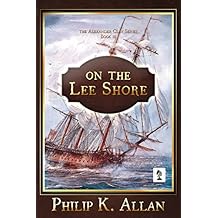
On The Lee Shore by Philip K Allan

Shortlisted for Book of the Month
A #DDRevs Diamond Read

On The Lee Shore (Alexander Clay Book 3)
AMAZON US   

Alexander Clay series #3

Nautical / Fictional Saga
18th Century
English Channel

Alexander Clay is now a Post Captain following his exploits in the first two volumes and his first command is a tough one: the crew of the Titan have mutinied and deposed their ruthless captain. Unable to identify the ring leaders, Clay restores certain activities – such as music on deck – and wins round the majority of the crew. But he still needs the help of some of his former shipmates.

Also in his camp is Sir Edward Pellew, a nod to Forester here, but Pellew was a real person, active at this time.  Pellew orders the Titan to take part in the blockade of a French port and here Clay proves his worth once again, as do the majority of his crew, but mutiny is still brewing and when the fleet rebels en masse, things don't look promising for Clay. Despite all this, love could still be in the air for our intrepid Captain ...

Mr Allan follows a a tried and tested formula; other captains are either tyrants or weak and they all look to support the 'gentlemen' rather than the talented. Pursers are sly and penny-pinching, everybody on board has a secret, whether good or bad and there are a lot of 'buddy' relationships covering all decks. What, for me, elevates the author to the heights of Forester, Kent and O' Brian, is the magnificence of the descriptions of life at sea, the hazards of sailing and the really authentic-sounding dialogue incorporating the odd-sounding nuances of the times.

There were a few typos in my file and, as with all series, it is always best for  readers to acquaint themselves with the earlier volumes. There are, however, enough references to previous activities to make this perfectly readable as an independent story. I would have liked to have seen a date at least at the beginning if not as part of some chapter headings and perhaps a map, but that was no great omission as most of the action takes place in one place.

I can heartily recommend this book in its own right, but especially to followers of the other authors in this genre mentioned above.

© Richard Tearle


click here to return to home page 'Bookshelf' then scroll down for more items of interest